
II.13. Прочтите и переведите текст С.
Text С
Chemical Hazards and Toxicity
All chemical products should be handled only by qualified individuals trained in laboratory procedures and familiar with the potential hazards. Some chemicals are extremely toxic or otherwise hazardous.
Every day, laboratory and hospital staff are exposed to many hazardous agents. Mercury is one of them. It is well known that mercury and its compounds are highly toxic. They can be handled safely, but stringent precautions must be taken to prevent absorption by inhalation, by ingestion, and through the skin. The main result of acute poisoning is damage to kidneys. Both organic and inorganic mercury compounds if ingested cause vomiting, colic and diarrhea, and both are skin irritants. Aryl salts of mercury affect the central nervous system, and alkyl salts are capable of penetrating brain cells. They are only slowly excreted.
In hospitals, mercury is used in various ways: in sphigmomanometers and thermometers, in counters and other devices used in the diagnostics and treatment. Mercuric chloride is part of Zenker’s solution used in pathologic laboratories to prepare tissue specimens. Hospital and laboratory personnel are usually exposed to mercury as a result of spills or when thermometers are sterilized or centrifuged, or when sphygmomanometers are reactivated.
Mercury concentration of 0.1 mg per cubic meter of air is toxic. It can be absorbed through the skin, airways, and gastrointestinal tract and stored in the bones, liver, kidneys, and the brain. Mercury spills should be cleaned with special mercury vacuum-cleaners; disposable equipment and a water-soluble mercury decontaminant should be used.
Hazardous products are marked with Hazard Symbols and Risk and Safety Phrases in accordance with the rules of the European Community Commission. This information is given on the product labels. The label reflects the latest legislation and knowledge and therefore provides the most applicable and most current information. An example of the new label, with a detailed description of each component, is shown below.
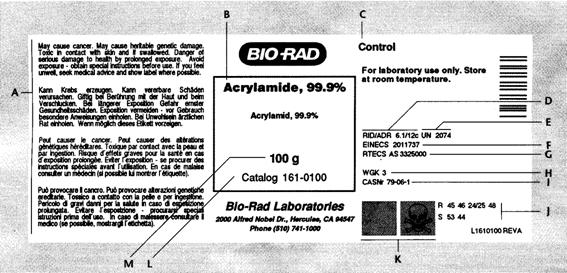
A. Risk and Safety Phrases (English, German, French, Italian)
B. Product Name
C. Control Number
D. Swiss and European Hazard Classification for Transportation by Rail and Road
E. U.S. Department of Transportation Identification Number
F. European Inventory of Existing Chemical Substances
G. NIOSH Registry of Toxic Effects of Chemical Substances
H. German Water Hazard Classification
I. CAS (Chemical Abstract Service) Number
J. Risk and Safety Phrase Reference Numbers
K. Hazard Symbol(s)
L. Catalog Number
M. Volume or Weight
Note: The absence of a warning must not be interpreted as an indication of safety. On the basis of existing information, the hazard potential of many compounds cannot be completely assessed.
II.14. Найдите в тексте случаи употребления прилагательных или наречий в сравнительной или превосходной степенях и переведите предложения, в которых они содержатся.
II.15. Переведите предупредительные надписи на этикетке. Знакомо ли вам это вещество?
II.16. Соедините в пары следующие пиктограммы, предупреждающие об опасности с описанием вида, опасности и мер предосторожности.
 Explosive
| Hazard: Caution: Hazard: Caution: Hazard: Caution: Hazard: Caution: Hazard: Caution: | Spontaneously flammable substances. Chemicals igniting in air. Avoid contact with air. Cases, gas mixtures (also liquified ones) which have an ignition range with air at normal pressure. Avoid formation of flammable gas-air mixture. Substances sensitive to moisture. Chemicals which readily form flammable gases on contact with water. Avoid contact with moisture or water. Liquids with flash point below 21 °С. Keep away from open fires, sources of heat and sparks. Solid substances which ignite easily after a short-term effect of a source of ignition. Avoid all contact with all sources of ignition. |
 Toxic
Toxic
| Hazard: Caution: | Oxidizing substances can ignite combustible material or worsen existing fires and thus make fire-fighting more difficult. Keep away from combustible material. |

| Hazard: Caution: | This symbol designates substances which may explode under definite conditions. Avoid shock, friction, sparks, and heat. |

| Hazard: Caution: Hazard: Caution: | Inhalation and ingestion of, or skin penetration by these substances is harmful to one's health. Non-recurring, recurring, or lengthy exposure to these substances may result in irreversible damage. Avoid contact with the human body, including inhalation of the vapors and in cases of malaise, consult a doctor. This symbol designates substances which may have an irritant effect on skin, eyes, and respiratory organs. Do not breathe vapors and avoid contact with skin and eyes. |

| Hazard: Caution: | Living tissue as well as equipment are destroyed on contact with these chemicals. Do not breathe vapors and avoid contact with skin, eyes, and clothing. |

| Hazard: Caution: | The substances are very hazardous to health when breathed, swallowed, or in contact with the skin and may even lead to death. Non-recurring, recurring, or lengthy exposure to these substances may result in irreversible damage. Avoid contact with the human body and immediately consult a doctor in cases of malaise. |
Дата добавления: 2018-02-15; просмотров: 384; Мы поможем в написании вашей работы! |

Мы поможем в написании ваших работ!